Run auditable AI on hardware you own.
Work with Antshiv Robotics to bring open models, verified kernels, training research, and distributed CPU systems onto infrastructure you control.
Commercial engineering, research collaboration, contribution, education, and sponsorship are all live paths. Start with a concrete model, kernel, platform, or validation problem.
When control of the runtime is the requirement
When policy, privacy, availability, or incident response must remain under your control, a hosted API is structurally the wrong runtime. A paid subscription still leaves model access, retention, acceptable-use policy, availability, pricing, and incident assistance under the provider’s control — and the Hugging Face security incident is concrete evidence that a frontier subscription does not guarantee defensive assistance when it is needed.
Data that never leaves
Training and inference where the data lives — your building, your cluster, your jurisdiction. Nothing ships to a third-party API to become someone else’s retention problem.
No dependency on a provider’s policy
Model access, acceptable-use policy, availability, and pricing stay under the provider’s control even on a paid plan. Generated C you can read, keep, and audit does not.
When the provider can’t help
The Hugging Face security incident showed the boundary: when defensive assistance is needed, a subscription does not guarantee it. Owned infrastructure keeps the incident boundary in your hands.
When the queue says no
GPUs get rationed, repriced, and allocated away overnight. CPU clusters you already own don’t wait in that queue.
Built for exactly this gap
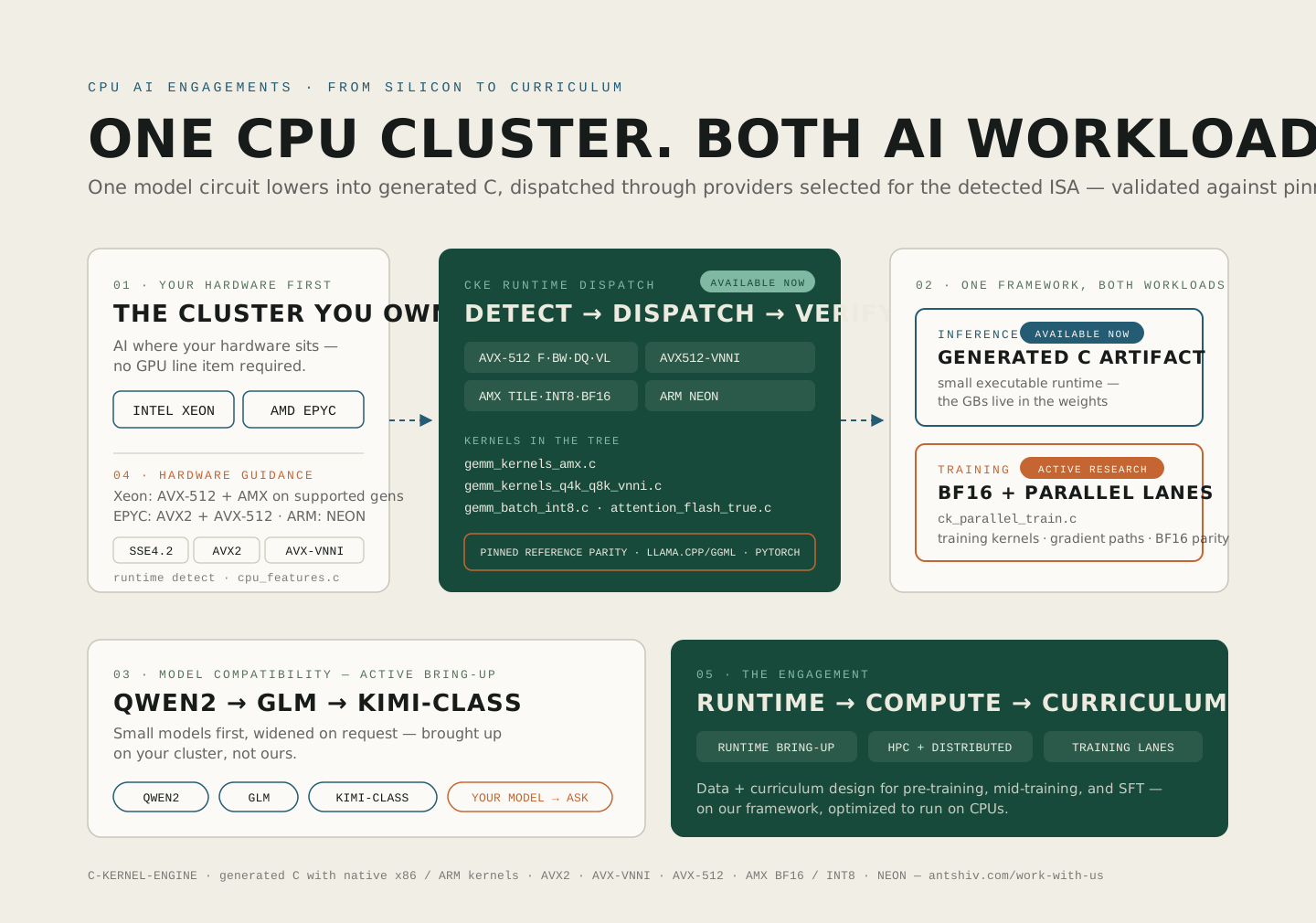
One model circuit lowered into generated C, dispatched through providers selected for the detected ISA, with numerical behavior validated against pinned reference implementations. CKE turns hardware you have into AI you can defend.
“When policy, privacy, availability, or incident response must remain under your control, a hosted API is structurally the wrong runtime.”
What an engagement delivers
CKE — our C-first framework optimized for CPUs — turned toward your models, your cluster, and your evidence requirements. Status labels separate demonstrated capability from active research and planned work.
AI on infrastructure you own
Open-model inference on your local infrastructure — especially CPU-class clusters — as generated C with native CPU kernels. Keep the workload where your hardware sits instead of renting GPU capacity.
Training lanes, stated precisely
Hardened training kernels, gradient paths, smoke tests, and BF16 parity work — the infrastructure for CPU training. Full pre-training or fine-tuning of every supported inference model is not yet claimed.
Bring-up, widened on request
Families in active compatibility work span small Qwen2 through GLM and smaller Kimi-class models. A special request means we bring the model up on your hardware — with parity evidence, not a promise.
What we recommend
x86-64 or ARM. Intel Xeon: AVX2, AVX-VNNI where available, AVX-512, and AMX BF16/INT8 on supported generations. AMD EPYC: AVX2 and AVX-512 on supported generations — AMX is Intel-only. ARM: NEON on supported targets.
Runtime to curriculum
Runtime bring-up, training infrastructure, high-performance compute, and data plus curriculum design for pre-training, mid-training, and SFT research — using our framework optimized to run on CPUs.
How the engagement works
Your Xeon, EPYC, or ARM cluster is the input. CKE detects the silicon and dispatches providers selected for that ISA — AVX-512 and AMX BF16/INT8 on supported Xeon generations, AVX2 and AVX-512 on supported EPYC generations, NEON on ARM.
CKE validates numerical behavior against pinned reference implementations, including llama.cpp/ggml and PyTorch where applicable. Inference is demonstrated; training is infrastructure-first active research; distributed CPU AI is planned research.
Why this matters on modern Intel Xeon
Modern Xeon is where the CKE thesis compounds: capacity, vector and tile engines, and observability in one socket. Partner hardware would directly accelerate the lanes marked active research and planned.
Weights live in memory
Large memory capacity and memory-channel bandwidth feed big models without a GPU HBM ceiling — the workload scales with DIMMs, not VRAM.
Vector and tile engines
AVX-512 on supported generations, and AMX BF16/INT8 turning sockets into serious matrix engines for inference today and training research next.
More of the machine per socket
Larger core counts and last-level cache keep parallel lanes busy and hot weights resident.
Observability is the moat
Hardware performance counters, perf, and VTune let kernel claims be measured and profiled, not asserted — the same discipline as CKE’s parity gates.
Data movement next
DSA and high-speed, RDMA-class networking are future data-movement research lanes — framed as planned until demonstrated evidence exists.
Harden one socket, then scale
Single-node hardening precedes multi-node expansion — measured, reproducible lanes before any distributed claim.
What is demonstrated, and what partner hardware unlocks
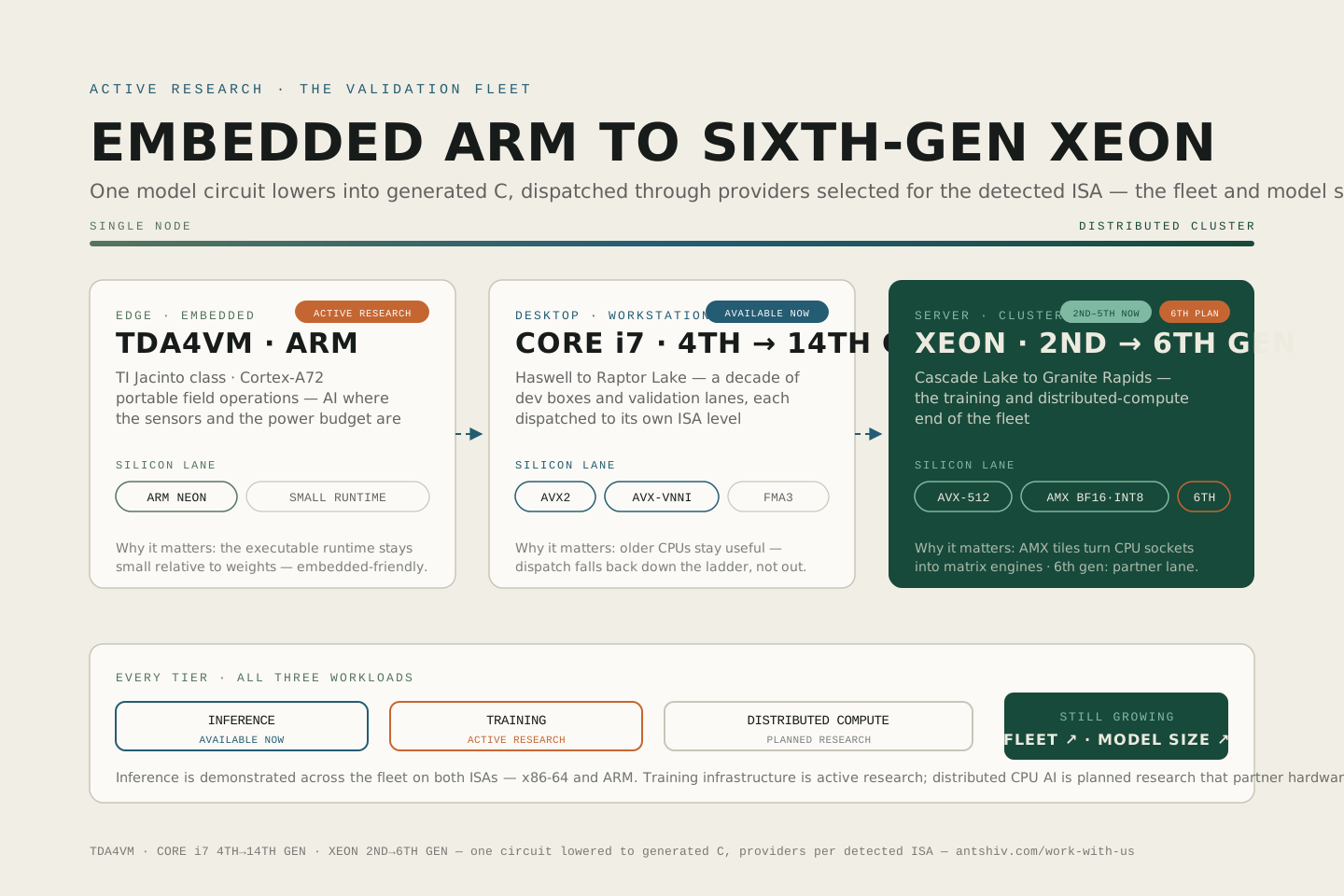
The fleet spans embedded ARM boards in the TDA4VM class, a decade of Core i7 from 4th to 14th gen, and Xeon servers from 2nd gen upward. One model circuit lowers into generated C and dispatches through providers selected for the detected ISA — older silicon stays useful instead of being retired.
Inference is demonstrated across the fleet. Training infrastructure is active research. Sixth-gen Xeon lanes and distributed CPU AI are planned work that partner hardware would directly accelerate.
Choose the relationship that matches the work
Technical partnership, research collaboration, hardware sponsorship, education, and open-source contribution. Recognition follows the engineering contribution, and claims, ownership, scope, and evidence stay explicit.
Joint CPU AI engineering
Model-family bring-up, numerical-parity investigation, CPU performance engineering, and hardware validation on infrastructure you control.
Shared questions, shared evidence
Training-kernel and curriculum research, single-node and future distributed CPU AI, with explicit claims and reproducible artifacts.
Laboratory and platform access
CPU nodes, memory, storage, networking, and specialist systems become public reproducible validation lanes with agreed evidence boundaries.
Technical notebooks and teaching
Notebooks, diagrams, demonstrations, and curricula that teach AI from model behavior down through circuits, kernels, memory, and hardware.
Public CKE development
Reproduce an issue, add a platform lane, improve a kernel, or strengthen a numerical oracle. Start with the repository and a concrete issue.
Bounded embedded and control work
Embedded systems, flight-control mathematics, simulation, sensor fusion, and firmware are the consulting path — bounded, paid, and evidence-gated.
Inspect before you engage
Every claim on this page has a public surface. Start anywhere — the code, the docs, or the nightly evidence.
CKE documentation
Architecture, circuits, kernels, and contracts in the public docs site.
CKE GitHub repository
The runtime, kernels, codegen, and parity harness in the open.
Nightly validation evidence
Nightly validation surfaces, measured runs, and reproducible artifacts.
How CKE is built
The pipeline from checkpoint to generated C, ISA dispatch, and parity gates.
Platform notes in the public tree
Supported-platform notes, multi-architecture work, and hardware lanes tracked in the open.
Engineering intake
Bring a model, kernel, platform, or validation problem with an evidence boundary.
Send enough evidence to make the next decision
A short, specific message is more useful than a broad partnership pitch.
The question
What exact behavior, limitation, model, platform, or research question are you addressing?
What exists
Link the source, paper, hardware, reproduction, measurements, or prior attempt.
Your proposed role
State what you can contribute and what you need from Antshiv Robotics.
The evidence boundary
Explain what result would count as progress and what remains unknown.
Antshiv Robotics builds intelligent systems we can understand all the way down, from mathematical kernels and CPU runtimes to simulation, flight control, and autonomous machines.